
Coloring Supplies
Best Paper for Coloring Pages: A Guide for Pencils, Crayons and Markers
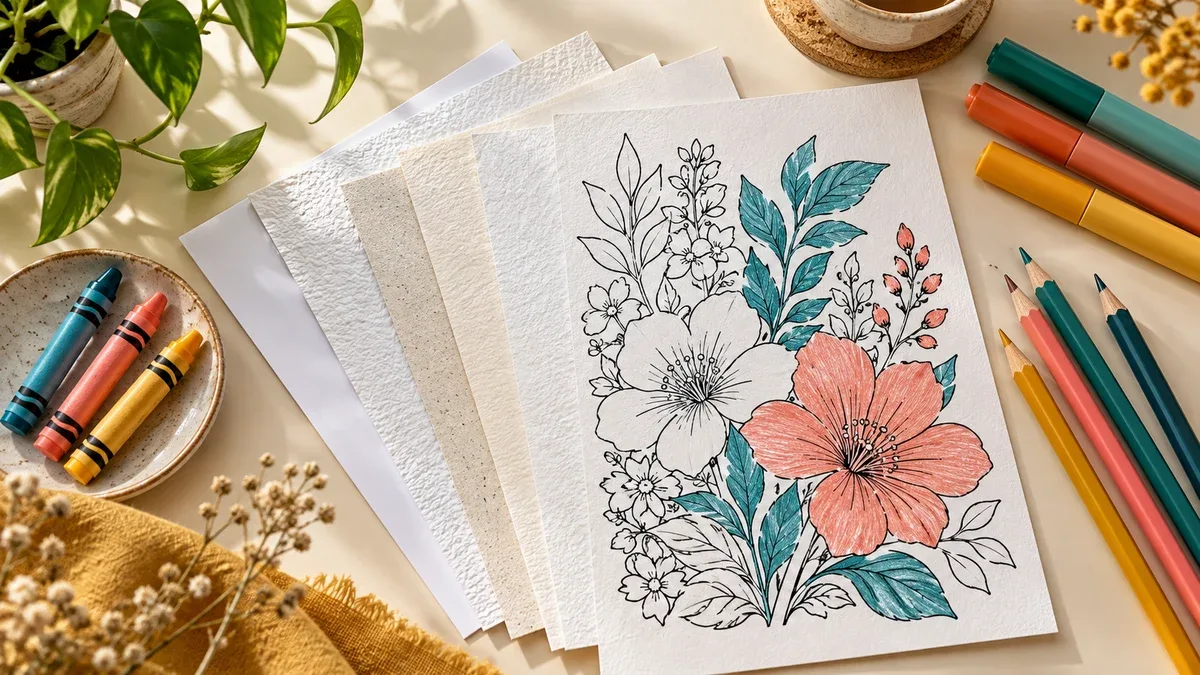
Choosing paper for coloring pages feels confusing. Store shelves hold dozens of weights, finishes and prices, and every label sounds important. Let us keep it simple.
Quick answer: For crayons and light pencil work, use smooth printer paper between 75 and 120 gsm. For many pencil layers, try vellum Bristol. For markers, use paper made for markers or smooth Bristol. Always check your printer’s maximum weight first.
This guide explains gsm and pound labels, tooth, coatings and marker bleeding. It also covers printer limits, cardstock, a simple paper test and budget picks. Last reviewed: October 2026.
Need pages to test on? Browse our free coloring pages, and read our guide on how to print coloring pages if you need help with settings.
In this guide
Best paper by coloring tool
Use this table as a starting point. Then confirm your pick with the simple paper test later in this guide.
Your tool | Start with | Upgrade to | Watch out for |
|---|---|---|---|
Crayons | Plain printer paper, about 75 to 90 gsm | Light cardstock for sturdy pages | Thin paper that tears under heavy pressure |
Colored pencils | Smooth printer paper, about 90 to 120 gsm | Vellum Bristol or drawing paper | Very rough paper that leaves white specks |
Gel pens and fineliners | Smooth paper, about 90 to 120 gsm | Smooth Bristol | Ink that smudges before it dries |
Water based markers | Smooth paper, about 120 to 160 gsm | Mixed media paper | Pilling and feathering |
Alcohol markers | Marker paper or smooth Bristol | Heavy blending card | Bleed through to the table |
Watercolor pencils | Mixed media or watercolor paper | Cold press watercolor paper | Paper that buckles when wet |
Notice that heavier paper does not always win. A thin marker paper with a barrier can beat a thick sheet without one. So match the surface to the tool first, and check the weight second.
What GSM and pound labels mean
GSM means grams per square metre. It tells you how much one square metre of paper weighs. Typical office paper weighs about 80 gsm. A higher number usually means a heavier sheet, but it does not directly measure thickness, stiffness or ink resistance.
Pound labels cause more confusion. In the United States, makers weigh a ream of 500 sheets, but different paper types use different sheet sizes. Bond paper uses 17 by 22 inches, and cover paper uses 20 by 26 inches. So a 65 lb cover sheet is much heavier than a 65 lb bond sheet would be.
US label | About how many gsm | What it feels like |
|---|---|---|
20 lb bond | 75 | Standard copy paper |
24 lb bond | 90 | Bright, slightly heavier printer paper |
32 lb bond | 120 | Heavy printer paper, a popular pick for coloring |
65 lb cover | 176 | Light cardstock |
80 lb cover | 216 | Medium cardstock |
110 lb index | 203 | Stiff index stock |
Always trust the gsm printed on the package when you compare different types. Also keep weight, brightness and opacity separate. Brightness describes how white the paper looks. Opacity describes how easily you see through it. Neither one stops a marker from reaching the back.
Texture, tooth and coatings
Texture is often called tooth. Picture the surface as tiny peaks and valleys. Light pressure colors the peaks first, and more layers slowly fill the valleys.
Smooth or vellum?
Strathmore explains that smooth Bristol has little to no tooth, so it suits pens, fine pencils and markers. Vellum has more tooth, so dry media such as colored pencils grab it better. Read the full comparison in Strathmore’s guide to Bristol paper.
Choose smooth when your page has tiny details. Choose vellum when you love visible pencil texture and many layers. Remember that the same brand can offer both, so check the label.
Coated and glossy paper
Uncoated white paper gives you a dependable baseline. Glossy photo paper does a different job. Its coating can make pencils slip and change how markers dry, so skip it for most coloring pages.
Marker paper with a barrier
Some marker papers use a coating that controls how deep ink travels. For example, Canson’s XL Marker paper weighs only 70 gsm and still includes an ink barrier. That shows a thin specialist sheet can beat a much heavier ordinary one.
Crayons, colored pencils and gel pens
Crayons
Start with the paper you already own. A little texture helps the wax catch. If a child tears the sheet or presses hard, switch to a sturdier sheet and slide a firm surface underneath. You can also mount the finished page on card later.
Colored pencils
A little texture gives pigment a place to settle. Very rough paper leaves white speckles, while very slick paper limits layering. For many layers, try smooth printer paper at 90 to 120 gsm, or move up to Bristol. Our guide on how to color with colored pencils shows how layers behave on different surfaces.
Gel pens and fineliners
Test gel pens on a smooth sample, and let the ink dry before you rest your hand on it. Smooth paper gives crisp lines, while rough paper can skip.
Paper for markers and marker bleeding
People use the word bleeding for several different problems. Name yours before you change supplies.
Bleed through: ink travels through the sheet and reaches the back or the surface below.
Show through: you see the color from the back because the sheet lacks opacity, even though the ink did not reach it.
Feathering: ink spreads sideways past the edge you wanted.
Pilling: rubbing and moisture lift small paper fibers from the surface.
A thicker sheet helps with some of these problems, but it cannot promise a clean back. Ink type, coating, absorbency, stroke speed and extra layers all change the result.
Canson notes that ink can pass through some Bristol and ordinary papers in its guide to alcohol marker paper. Independent tests of marker papers also report that copy paper dries too fast for smooth blending, and that thicker paper does not guarantee better blending. So test your own marker on your own paper.
A simple marker test
Print or draw a small shape on the paper.
Color one quick pass with your marker.
Color a second area with three blended layers.
Wait until the ink dries.
Check the back and the sheet underneath.
Not sure which marker suits you? Read our comparison of crayons, colored pencils and markers.
Watercolor pencils and wet media
Watercolor pencils and water brush pens need paper that tolerates water. Mixed media paper or cold press watercolor paper works best. Thin copy paper buckles and tears when wet.
Printing on watercolor paper can also go wrong. Its surface sizing can give mixed results in inkjet printers, and its thickness may exceed your printer’s limit. When that happens, transfer the design or ask a print shop to handle the stock.
Check your printer before you buy paper
A paper can feel perfect for pencils and still jam your printer. So check the supported media before you buy a pack.
What printer makers say
Epson’s European support page states that its printers accept plain paper from 64 to 90 gsm, including third party brands. It recommends genuine Epson media for heavier sheets, and its limit reaches 300 gsm only with that media. See the Epson paper weight FAQ. Canon’s manual for the TS5300 series lists plain paper from 17 to 28 lb, or about 64 to 105 gsm. These numbers apply to specific models, so look up yours.
Laser printers have limits too. A retailer guide reports that most laser printers accept about 163 to 220 gsm through the main tray, and that heavier stock usually needs the bypass tray. Always follow your own manual.
Setup steps
Find your printer model’s supported weight and media list.
Check that the paper suits inkjet or laser printing.
Use the tray or manual feed that the maker recommends.
Select the matching paper type in the print driver, such as Heavy or Cardstock.
Print one sheet and inspect feeding, line quality and adhesion.
Never force thick paper through a printer that does not support it. A rear feed does not automatically accept every cardstock. And never load a sheet with glue, loose glitter or stuck on decorations. If your favorite art paper will not feed, print on a suitable sheet and mount it later.
New to printing at home? Our guide on how to print coloring pages covers the settings step by step.
Cardstock for coloring pages
Cardstock usually weighs between 135 and 300 gsm. It adds stiffness, which helps bookmarks, cards and sturdy keepsakes.
Pros: it feels sturdy, it resists tearing and it stands up to heavier marker use.
Cons: it can jam printers, it can cost more and its surface may feel wrong for some pencils.
Best for: cards, bookmarks, puzzles and pages you want to display.
Lighter cover stock around 176 gsm often prints more easily than heavy cardstock. Check your printer’s limit before you buy a ream.
Run a simple paper test
Use the same small design, tools and settings on every sheet. That way, the artwork cannot sway your choice.
Print a sample with a fine outline and a larger enclosed shape.
Add one light pencil layer, then several more in one area.
Make a light and a firm crayon patch.
If you use markers, test one pass and a blended area over a backing sheet.
Let the sample dry, then check the edges, front, back and backing sheet.
Write the paper name and gsm in the margin so you can repeat the result.
Then score what matters to you: clean outlines, comfortable coloring, an acceptable back, easy feeding and price per usable sheet. The winner for a classroom activity may differ from the winner for a piece you want to frame.
Budget picks for kids, classrooms and big batches
Compare the cost per successful print, not the price of the ream. A cheap ream saves little if half of it fails your marker test or jams the printer.
Kids and crayons: standard 75 to 90 gsm printer paper.
Classroom with washable markers: 90 to 120 gsm paper and a backing sheet under every page.
Detailed pencil work at home: a small pack of smooth or vellum Bristol that your printer accepts.
Alcohol markers: a small pack of marker paper, and test before you buy more.
Start with a small pack or a few sample sheets. Then add specialist paper only when a project needs it.
Acid free paper and keeping your artwork
The Society of American Archivists defines acid free paper as paper with a pH of 7.0 or higher when manufactured. That matters when you want to keep a page for years. Still, paper choice alone cannot stop fading, so store pages flat, dry and away from strong light.
For ideas on what to do with pages you love, see what to do with finished coloring pages.
Common paper mistakes
Buying the heaviest paper before you check your printer.
Judging paper by a blank sample instead of your real drawing.
Assuming one gsm number fits every marker.
Using glossy photo paper for pencils.
Skipping a backing sheet under markers.
Mixing up pound labels from different paper types.
How we wrote this guide
We compared the top ranking paper guides and checked weights and limits against manufacturer and reference sources, including Strathmore, Epson, Canon and the Society of American Archivists. We marked printer limits as model specific, because they vary. Last reviewed in October 2026.
Common questions
What is the best paper to print coloring pages on?
For most people, smooth white printer paper between 90 and 120 gsm works well. It feeds through printers, holds pencils and handles crayons. Upgrade only the property that disappoints you.
Is cardstock good for coloring pages?
Yes, for cards, bookmarks and keepsakes. However, it can exceed your printer’s limit, and some pencils feel less comfortable on it. Check your printer first.
What GSM is best for coloring pages?
About 90 to 120 gsm suits most tools. Use 75 to 90 gsm for crayons, and move up for heavy layering or markers.
What paper stops markers from bleeding through?
No weight guarantees that. Look for paper made for markers, test repeated layers and slide a backing sheet underneath.
Can I use copy paper with alcohol markers?
You can, but copy paper dries ink too fast for smooth blending, and bleed through is common. Marker paper or smooth Bristol works better.
Can I print on Bristol or watercolor paper?
Only when your printer supports that thickness and surface. Otherwise, transfer the design or use a print service that handles the stock.
Is inkjet or laser better for coloring pages?
Both work. Laser toner resists smearing under wet markers. Inkjet ink can run, so let prints dry and test a corner first.
Do I need acid free paper?
Not for casual coloring. Choose it when you want to keep or display a page for a long time.
Can I use recycled paper?
Yes, if its surface, weight and print compatibility suit your tool. Test it like any other paper.
What should I buy first?
Try your existing uncoated printer paper with your favorite tool. Then upgrade only what disappoints you, such as stiffness, layering or marker behavior.